
Walk onto the casino floor of any major resort today, and the blackjack pit looks inviting. Bright felt, energetic dealers, and accessible table minimums make the game feel as approachable as ever. Yet stamped directly onto the felt of an alarming number of these tables is a subtle phrase that fundamentally breaks the game: “Blackjack Pays 6 to 5.”
To an untrained eye or a casual weekend bettor, the difference between 6:5 and the traditional 3:2 payout sounds trivial. Some beginners even mistake six-to-five for a better deal simply because both numbers are larger. In reality, this single rule change represents the most aggressive shift in casino math over the last two decades. It transforms blackjack from one of the fairest games in the building into an expensive mathematical meat grinder.
The Illusion of a Harmless Ratio
Blackjack earned its reputation as the premier table game for disciplined players because standard rules offer an exceptionally low house advantage. When played with proper basic strategy under fair rules, the house edge typically hovers around 0.5%. That slim casino advantage is entirely dependent on the premium you receive when you hit a natural twenty-one.
A natural blackjack is the player’s primary compensation for all the hands where the dealer draws out, doubles fail, or splits collapse. Under the time-honored 3:2 standard, the house rewards you with $1.50 for every dollar wagered. On a standard $10 bet, you pocket $15. On a $25 wager, you collect $37.50.
At a 6:5 table, that payout drops to $1.20 for every dollar wagered. That same $10 bet returns just $12. A $25 bet yields only $30.
Losing three dollars on a ten-dollar wager or seven dollars and fifty cents on a twenty-five-dollar wager might not seem catastrophic on a single hand. However, casino mathematics does not care about single hands; it operates on volume, probability, and cumulative distribution.
Dissecting the Math: The Immediate Cost to Your Bankroll
To understand why this reduction is devastating, look at how frequently a natural blackjack actually occurs.
In a standard six-deck shoe, the probability of receiving an Ace and a ten-value card on your initial two-card deal is roughly 4.75%. That equates to approximately once every 21 hands.
If you sit at an average table dealing 70 to 80 hands per hour, you can expect to hit three to four blackjacks every sixty minutes. At a $25 table, the difference between collecting $37.50 and $30 is $7.50 per occurrence. Over four blackjacks in a single hour of play, you forfeit $30 in pure profit straight to the casino.
That thirty-dollar loss is completely independent of whether you played well, whether you hit a hot shoe, or whether you managed your splits properly. It is an immediate, unrecoverable tax on your best possible outcome. Over an average four-hour gambling session, a $25 bettor surrenders $120 in baseline expectation simply by occupying a seat at the wrong table.
How 6:5 Multiplies the House Advantage
The structural impact on the house edge is staggering. Shifting the natural payout from 3:2 to 6:5 adds roughly 1.39% directly to the house edge.
Consider what that means in practical terms:
A standard shoe game offering 3:2, dealer hits soft 17, double after split allowed, and late surrender carries a house edge of around 0.5% to 0.6% against a basic strategy player. Changing nothing else about the game except altering the payout to 6:5 instantly spikes that edge to nearly 2.0%.
Casinos spend millions tweaking minor rules to shave fractions of a percent in their favor. Restricting double-downs to 10 and 11 costs the player about 0.18%. Taking away the option to resplit aces costs roughly 0.08%. Making the dealer hit instead of stand on soft 17 costs about 0.22%.
A 1.39% swing does not nudge the odds; it completely rewrites them. It quadruples the mathematical advantage the house holds over you. At a 2% house edge, blackjack stops being a skill-adjacent game of narrow margins and becomes worse than betting the pass line in craps (1.41%) or wagering on the banker in baccarat (1.06%).
The Psychology of the Lower Minimum
The 6:5 payout originated in the early 2000s in downtown Las Vegas as an experiment on single-deck games. The pitch to players was seductive: single-deck games traditionally offered the best odds, so operators introduced 6:5 payouts paired with $5 minimum limits, claiming the trade-off made the game accessible.
The experiment was an overwhelming financial success for the casinos. Tourists and casual players flocked to the low-minimum tables, completely unaware that the rule change destroyed any mathematical benefit a single deck provided.
Seeing that the public pushed back very little, casino operators rapidly expanded the practice. Today, 6:5 payouts are no longer restricted to single-deck novelties. They dominate multi-deck shoes on the main gaming floors of the Las Vegas Strip, regional commercial casinos, and cruise ship pits alike.
Casinos rely on player anchoring. A player sees a $15 table next to a $25 table and sits at the $15 table to protect their budget. Yet playing basic strategy at a 6:5 $15 table often drains a bankroll faster in expected loss than playing disciplined basic strategy at a 3:2 $25 table. The lower limit is an optical trick designed to disguise an aggressive pricing model.
Spotting the Table and Defending Your Action
Protecting your bankroll requires checking the table felt before laying down a single chip.
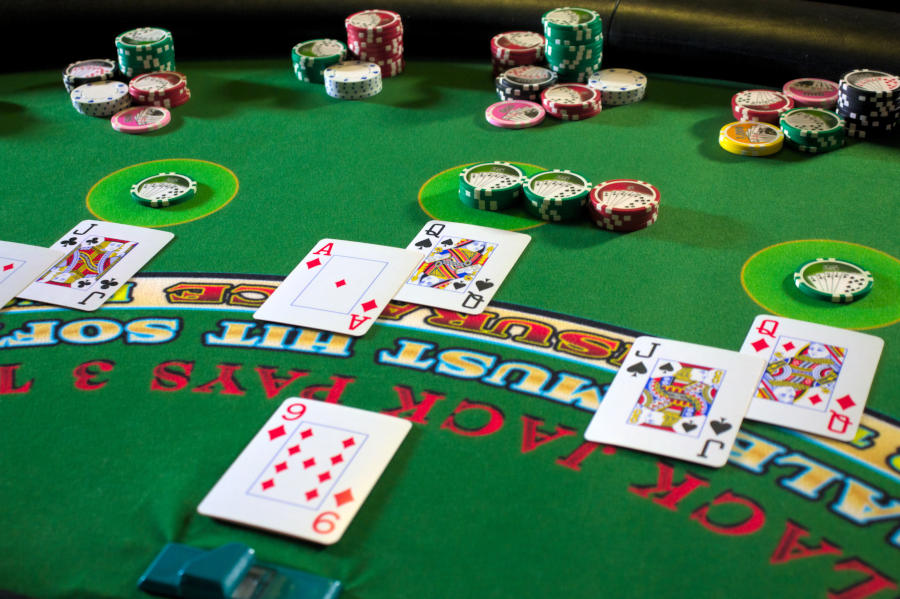
Casinos are legally required to display game rules on the table layout or on an adjacent placard. Look at the primary text arcing across the center of the felt. If it reads “Blackjack Pays 3 to 2”, the baseline math of the game remains intact. If it reads “Blackjack Pays 6 to 5”, walk away.
If a casino floor offers only 6:5 games at your preferred limit, your best strategic move is to alter your game selection entirely:
-
Seek out off-strip or local venues: In major gambling markets, off-strip casinos and local properties frequently preserve 3:2 tables at reasonable minimums to compete with destination resorts.
-
Inspect the high-limit room: Even if you typically play lower stakes, check the minimums in the salon. Sometimes a $50 minimum 3:2 table offers vastly better expected value and slower variance than grinding away at a crowded 6:5 table with high house extraction.
-
Pivot to other low-edge games: If only 6:5 blackjack is available at your price point, move to baccarat or the craps table. Placing the 6 and 8 or playing the pass line gives you substantially better odds than accepting a diminished blackjack return.
Blackjack remains the ultimate test of disciplined strategy, but no strategy can outmaneuver an artificially depressed payout on the game’s signature hand. Rejecting the 6:5 layout is the single fastest way to take control of your odds before the cards are even dealt.